





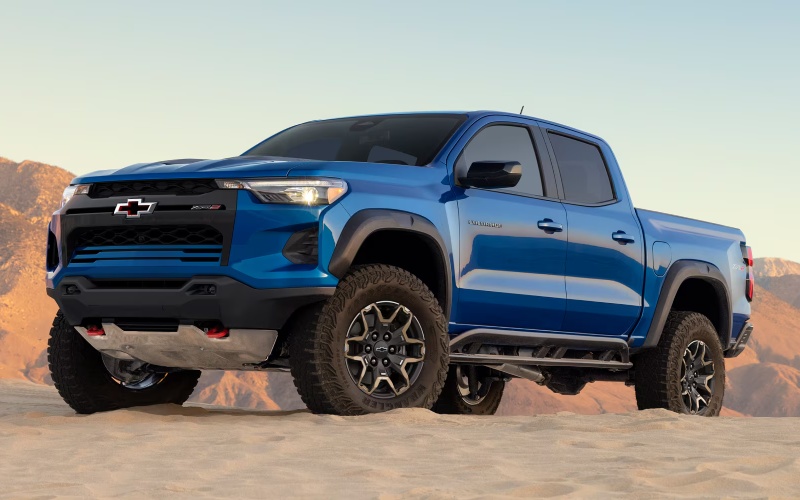
Curry Chevrolet – Which midsize truck to choose for towing near New Rochelle, NY?
If you’re narrowing your search to two heavy-hitting midsize pickups, you’re likely asking one big question: which truck is better for towing the gear you actually own near New Rochelle, NY? The 2026 Chevrolet Colorado brings best-in-class standard torque and a towing-focused tech package that’s easy to use, while the 2026 Ford Ranger counters with a broad engine lineup and a familiar interface. The difference shows up when you hitch a boat, camper, or landscaping trailer and head toward the Hutch or I-95. Standard power, accessible towing features, and a well-matched transmission tuning often make more of a difference than spec-sheet peaks that require pricey options.
Let’s start with torque, because that’s what moves you off the line and holds speed on a grade. The Colorado’s 2.7L TurboMax® engine delivers 310 horsepower and a best-in-class standard 430 lb-ft of torque across the lineup, so the muscle you need is baked in even if you choose a value-focused trim. When properly equipped, the Colorado offers up to 7,700 lbs of max available towing and pairs that capability with an enhanced 8-speed automatic that feels settled and decisive under load. The Ranger’s portfolio is strong, offering a 2.3L EcoBoost® four-cylinder, an available 2.7L EcoBoost® V6, and a high-output 3.0L EcoBoost® V6 in Raptor. Max available torque can meet 430 lb-ft on specific trims, and max available towing checks in at 7,500 lbs. In other words, the Ranger can be built to tow, but the Chevrolet starts there by default.
Beyond raw numbers, control and visibility make towing less stressful. Colorado’s available Trailering App integrates with the 11.3-inch center touch-screen to streamline pre-departure checks, trailer profiles, and integrated guidance while maneuvering. Up to 10 available camera views, including available underbody cameras, help you spot curbs, low posts, or a tight ramp approach that can surprise even experienced drivers. Ranger’s available 360-Degree Camera is useful for parking lot navigation, and its towing technologies support confident hookups, but the breadth of the Colorado’s camera coverage is a practical advantage when backing down a steep or crowded launch near the Long Island Sound.
Stability and braking are just as important with a trailer. Colorado chassis options like Trail Boss and ZR2 emphasize planted control on uneven surfaces, aided by precise damping and, on ZR2, Multimatic® DSSV dampers that excel at controlling wheel movement over repeated hits. That extra poise shows up when your trailer bounces over expansion joints or you need to transition quickly from a paved road to a gravel ramp. Ranger’s FX4® Off-Road Package and Raptor tuning deliver strong composure as well, especially at speed, but the Colorado’s balance and traction aids are tuned to feel confident at the lower speeds where most backing and tight maneuvering take place.
Inside the cab, information flow matters. Colorado’s best-in-class standard 11-inch Driver Information Center keeps towing data central, reducing eye movement when you’re monitoring temps, gain, or navigation cues while merging or descending a grade. The Ranger’s available 12-inch cluster is crisp and informative, though it’s not standard across the lineup. Both trucks offer large center displays—Colorado at 11.3 inches and Ranger with an available 12-inch screen—plus smartphone integration through Apple CarPlay® and Android Auto™. The difference is the Colorado’s thoughtful standardization: critical towing aids arrive with fewer boxes checked, and familiar readouts are ready the first time you pull your trailer.
The bed is part of the towing story, too. Colorado’s StowFlex® tailgate with built-in storage and measurement tools makes it simple to stow tie-down straps, chocks, and a hitch lock where you can reach them. Up to 17 available tie-downs and an available 120-volt in-bed outlet make organizing and powering accessories straightforward. Ranger answers with an integrated box side step, available Zone Lighting, and Pro Power Onboard™—a smart way to power smaller tools at 400 W. Both beds work well; the Colorado simply prioritizes the small touches that keep towing gear tidy and ready.
Safety enhancements factor into the towing equation as well. The Colorado includes Chevy Safety Assist standard across the lineup, bundling six core driver-assistance features. Ranger’s Ford Co-Pilot360® Technology is widely available and adds helpful options like BLIS® (Blind Spot Information System) with Trailer Coverage. If you’re pulling a trailer through weekend traffic or navigating a dimly lit launch at dawn, having foundational driver-assistance tech as standard is reassuring.
So which truck makes the better towing partner around Westchester? If you value strong standard torque, intuitive in-cabin towing tools, and a camera system that reduces guesswork on tight ramps, the 2026 Chevrolet Colorado earns the edge for most local use cases. For shoppers who want to tailor a build for specialized off-road performance at higher speeds, specific Ranger configurations—especially Raptor—hold appeal. The key is to choose the truck that makes your towing routine simpler and safer right out of the box.
- Standard torque advantage: Colorado’s best-in-class standard 430 lb-ft delivers confident launches and steadier climbs without costly engine upgrades.
- Visibility where it counts: Up to 10 camera views, including available underbody cameras, simplify backing, slotting into storage, and navigating ramps.
- Bed utility for towing gear: StowFlex® tailgate storage and generous tie-downs make it easy to keep straps, locks, and tools organized and secure.
- Evaluate your trailer weight: Match your fully loaded trailer to the truck’s max available towing and consider payload for passengers and cargo.
- Check hitch and brake needs: Confirm receiver class, tongue weight, and whether your trailer’s brakes pair with the truck’s integrated controls.
- Test camera and display layouts: Ensure on-screen guidance and camera angles feel intuitive for your typical parking and launching environments.
At Curry Chevrolet, we encourage shoppers to bring their real-world scenarios—parking dimensions, launch conditions, gear lists—and we’ll walk you through the best configuration. Our team is serving New Rochelle, Yonkers, and White Plains with hands-on demos that show how features translate into calmer, more confident towing. The goal is simple: make sure your next truck feels like a natural fit for your day-to-day and weekend adventures.
Frequently Asked Questions:
Can the Colorado tow a 22-foot boat comfortably on hilly routes?
When properly equipped, the Colorado’s 7,700-lb max available towing and best-in-class standard 430 lb-ft of torque provide confident uphill pulls and stable braking downhill, aided by clear towing readouts on the 11-inch Driver Information Center.
How does the Ranger’s towing feel with the 2.3L EcoBoost® compared to the Colorado?
The Ranger’s 2.3L EcoBoost® is capable for lighter trailers, but the Colorado’s standard 430 lb-ft of torque generally requires less throttle and fewer downshifts under similar loads, which many drivers perceive as calmer and more predictable.
Do camera systems really help with trailer backing at tight boat ramps?
Yes. The Colorado’s breadth of available camera views, including available underbody cameras, helps you judge angles and obstructions you might miss in mirrors alone, which is especially helpful at tight or crowded ramps.
What if I primarily tow locally and only a few times per year?
That’s where the Colorado’s standardization pays off: you get the torque and foundational towing aids without stepping up to higher trims, so the truck is always ready for those occasional but important towing days.
Request more 2026 Chevrolet Colorado information


